
The Persuadability Illusion
Why most campaigns are targeting the wrong voters; and wasting millions because they misunderstand persuasion

Most campaigns operate as if persuasion is broad. It isn’t.
They assume the battlefield is filled with:
undecided voters,
loosely attached partisans,
and people waiting to hear the right message.
That assumption drives almost every modern campaign:
media plans,
persuasion universes,
message testing,
digital targeting,
direct mail,
and turnout strategy.
The problem is that much of it is built on a flawed premise. Most undecided voters are not persuadable. And many persuadable voters do not look undecided at all.
That is the persuadability illusion.
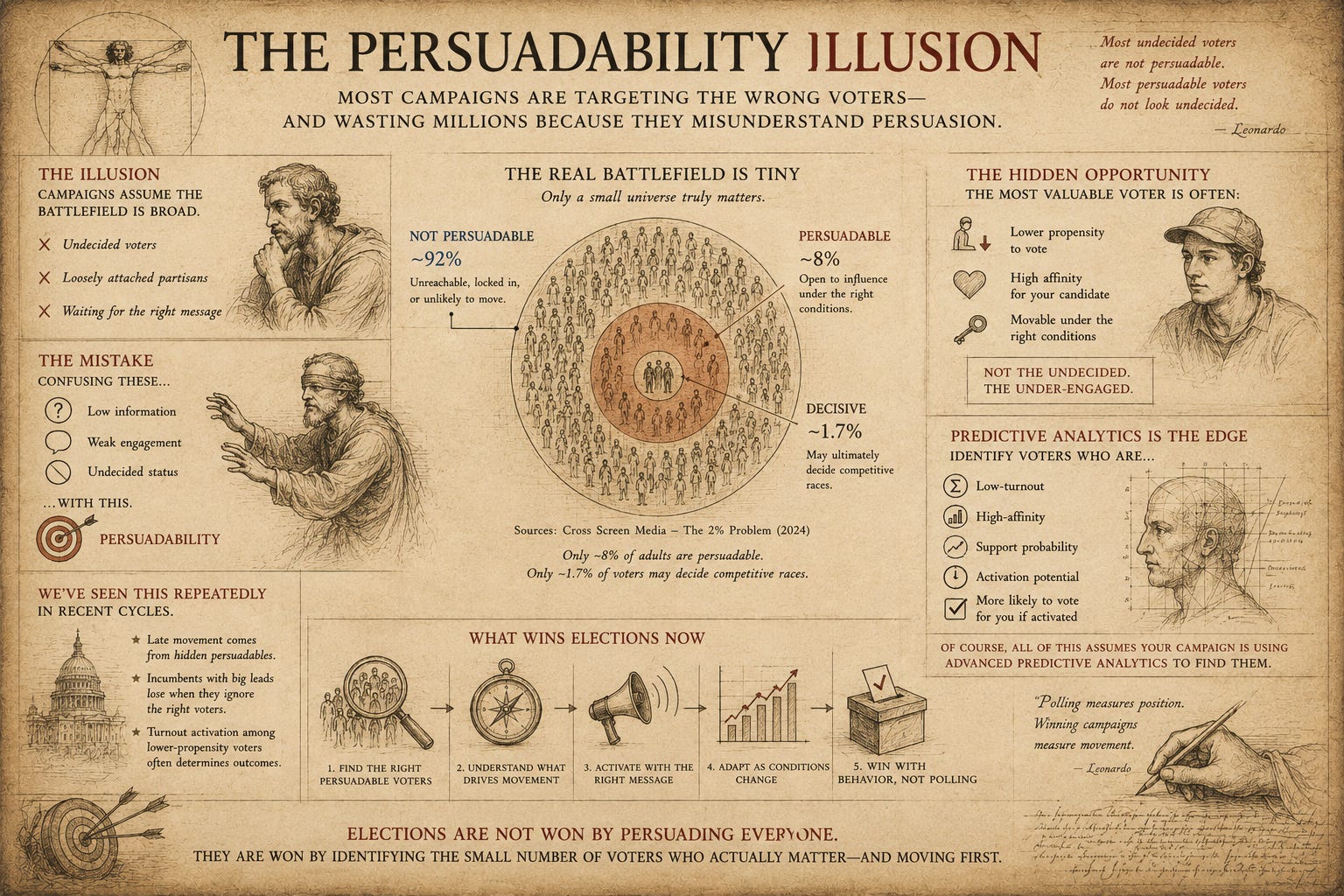
The Real Battlefield Is Tiny
A recent report from Cross Screen Media estimated that only about 8% of adults are persuadable, and only around 1.7% of voters may ultimately decide competitive races. I wrote about it here:

That is an astonishingly small slice of the electorate.
And yet campaigns still routinely build persuasion programs as though large portions of voters are fluid. They aren’t. Most voters are:
structurally partisan,
emotionally locked in,
habitually disengaged,
or simply unreachable.
The real opportunity exists in a much narrower segment:
voters who are lower propensity,
high-affinity,
and movable under the right conditions.
That distinction matters enormously. Because campaigns waste extraordinary amounts of money trying to persuade people who were never realistically going to move in the first place.
Undecided Does Not Mean Persuadable
This is one of the biggest mistakes in modern politics. Campaigns see:
low information,
weak engagement,
or undecided responses
and assume persuasion opportunity.
But many of those voters:
do not follow politics closely,
are unlikely to participate,
or are psychologically disconnected from the race altogether.
Meanwhile, some of the most persuadable voters in an election already appear “decided” in polling. Their support looks stable on the surface. But underneath, it is volatile.
That is where late breaks happen.
And it is why campaigns so often act shocked by outcomes that were visible long before Election Day. Polling measures position. Winning campaigns focus on movement probability.
Those are very different things.
This Is Where Predictive Analytics Changes Everything
Of course, all of this assumes your campaign is already using predictive analytics sophisticated enough to identify:
low-turnout voters,
high-affinity voters,
turnout likelihood,
support probability,
and activation potential.
That should not be viewed as exotic anymore. It should be table stakes (not to go all Nate Silver, as I don’t play poker, but did enjoy his last book). Because the most valuable voter in modern politics is often not:
the undecided voter,
or the high-information swing voter.
It is the voter:
unlikely to participate,
but disproportionately likely to support your candidate if properly activated.
That is where elections are increasingly won. Especially in primaries.
We’ve Seen This Repeatedly in Recent Cycles
In several recent Republican primaries, campaigns with massive spending advantages and stable polling leads still lost.
Why?
Because they misunderstood the actual persuasion universe.
In the 2024 Texas Republican primaries (and to a lesser extent in 2026), multiple incumbents appeared structurally secure until late movement developed underneath the surface.
The campaigns that adapted quickly:
identified persuadable clusters earlier,
recognized issue salience shifts faster,
and reallocated communication resources before the broader political environment fully recognized what was happening.
The same dynamic has appeared repeatedly in modern campaigns:
late-cycle movement,
compressed persuasion windows,
and turnout activation among lower-propensity voters who traditional polling often underestimates.
That is not random volatility. It is usually a targeting and movement problem.
AI Is About to Magnify This Gap
This becomes even more important in the AI era.
A recent study from researchers at Oxford, Stanford, the UK AI Security Institute, and the London School of Economics found that conversational AI significantly increased real-world political behavior and activism. (I wrote about it here):

But the key insight was deeper than the technology itself. The researchers found that: changes in political attitudes and changes in political behavior were often uncorrelated.
That finding reinforces something campaigns are beginning to confront: Persuasion is not broad. It is conditional. Behavioral. Identity-driven.
And highly uneven across the electorate.
Which means AI will not magically solve persuasion.
It will simply make sophisticated campaigns more efficient at identifying and activating the right voters. And it will make unsophisticated campaigns more efficient at wasting money on the wrong ones.
The New Campaign Divide
The future divide in campaigns will not simply be:
Democrat vs Republican,
digital vs television,
or AI vs traditional media.
It will increasingly be between campaigns that understand behavioral movement and campaigns that do not.
The winning campaigns will not necessarily persuade more voters overall. They will:
identify the right persuadable voters earlier,
understand what conditions drive movement,
and recognize activation opportunities before their opponents do.
That is the real battlefield now. And it is much smaller than most people think.
The Bottom Line
Most campaigns still think persuasion is a mass-market exercise. It isn’t.
The future belongs to campaigns that understand:
who can move,
who will actually vote,
and what conditions trigger action.
Because elections are not won by persuading everyone. They are won by identifying the small number of voters who actually matter—and moving first.