
The 2% Problem: Why More Content Doesn't Cut it in 2026

Campaigns in 2026 need to operate like full-time production studios—creating content constantly, across every platform, every day.
That’s where the world has gone.
But that’s not what will decide elections.
Because Elections Aren’t Decided by Everyone
They’re decided by almost no one.
A new report from Cross Screen Media lays this out more clearly than anything I’ve seen this cycle:
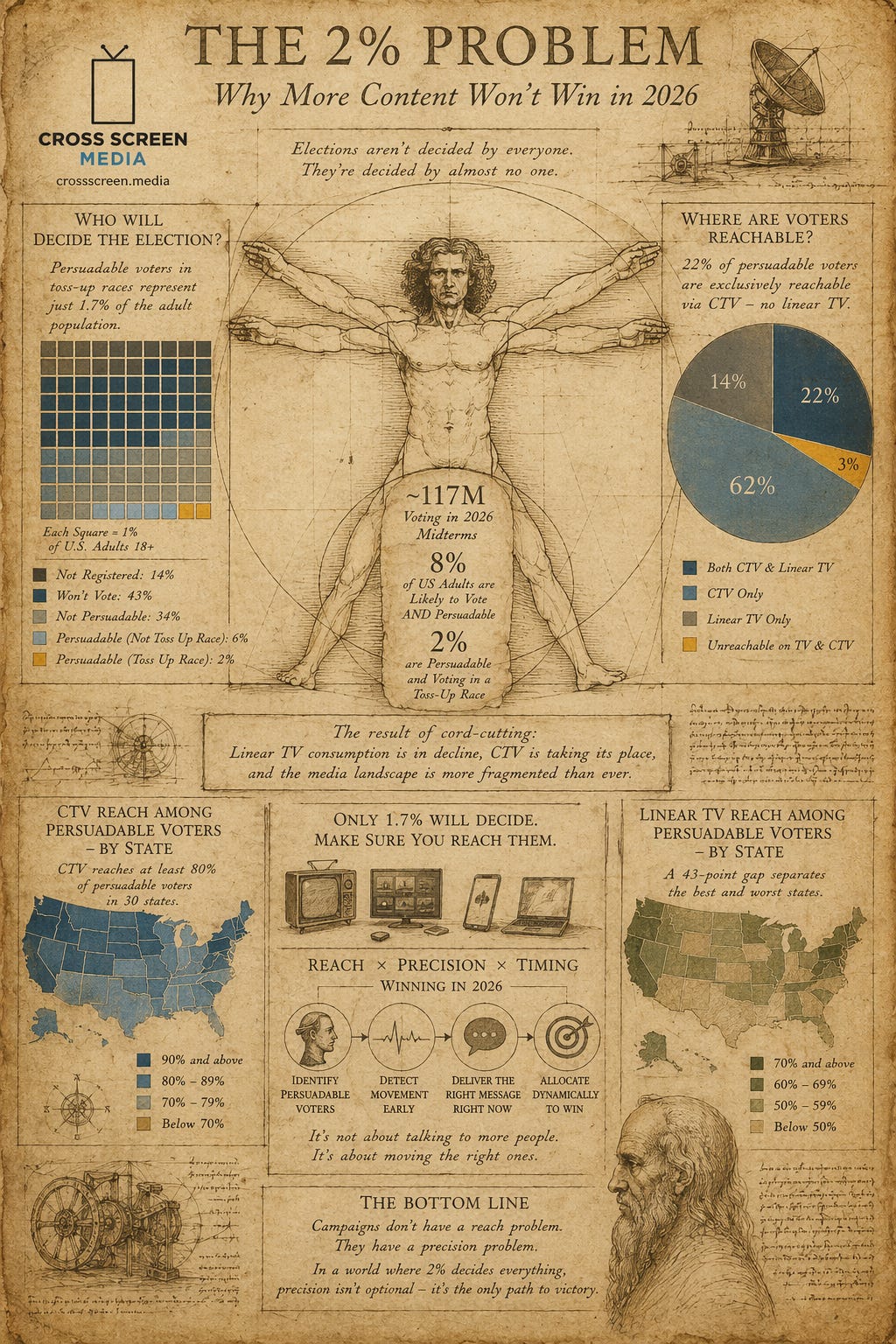
Roughly 1.7% of adults will decide control of Congress in 2026.
Let that sink in.
Campaigns are scaling content to reach millions…
…when the outcome is determined by a tiny, fragmented slice of the electorate.
The Industry Is Solving the Wrong Problem
Plouffe’s model is about production and distribution:
More content
More platforms
Faster execution
Cross Screen’s data is about reachability:
Where persuadable voters can be found
How media consumption is shifting
Which channels matter in which states
Both are right.
But they’re solving different halves of the same problem.
And the missing half is the one that actually decides outcomes.
The Real Constraint Isn’t Reach. It’s Precision.
Cross Screen shows that:
Only about 8% of adults are persuadable
Only about 2% are persuadable in competitive races
22% of persuadable voters are only reachable via CTV
And 14% can’t be reached via TV or CTV at all
That’s a targeting and timing problem, not a reach problem. All the media consultants screaming for more GRPs are missing the target.
Campaigns aren’t losing because they aren’t loud enough. They’re losing because they don’t know:
Which voters in that 2% actually matter
Which ones are still movable
And what will move them right now
Most Voters Aren’t Persuadable
This is the part campaigns still struggle with: a large share of the electorate is already locked in (even in primaries)
But not all of it.
And the difference between those two groups is every election is decided.
The challenge is that most campaigns don’t know which is which.
So they do what campaigns have always done:
They talk to everyone; and in doing so, they waste time (and money) on voters who will never move, and miss the ones who will.
From Content → to Movement
This is where the model needs to change.
The future isn’t just:
Produce more content
Distribute it everywhere
It’s:
Identify movement. Then act on it faster than your opponent.
That requires a different set of capabilities:
Persuadability — Who can still move
Issue salience — What matters right now
Message resonance — What actually spreads
Sentiment volatility — How stable support really is
Cross Screen helps answer:
Where can I reach them?
The next question is:
Who should I reach—and when does it matter most?
This Matters Even More in 2026 Primaries
General elections, even in non-prez years, are about scale.
Primaries are about precision.
Smaller electorates
Faster narrative shifts
Higher volatility
Late movement that actually matters
In that environment, reaching the wrong voters efficiently is still losing.
The New Operating Model
The campaigns that win in 2026 will combine both sides of this equation:
1. Reach (Cross Screen’s world)
Channel mix
Media consumption
Platform strategy
2. Movement (what most campaigns are missing)
Real-time sentiment
Persuadability modeling
Narrative detection
Dynamic reallocation
Put together, that becomes:
Reach × Precision × Timing
That’s the game now.
The Bottom Line
Campaigns are becoming media companies; that’s true.
But media companies don’t win elections.
Campaigns do.
And campaigns win by understanding something much more fundamental:
Not just where voters are
But which ones matter
And when they’re about to move
One Final Thought
Cross Screen’s report should be required reading for anyone building a media plan in 2026.
It’s one of the clearest looks at how fragmented, and how high-stakes, the reach environment has become (and it’s broken down by state).
The next step is connecting that reach to real-time voter movement.
Because in a world where 2% decides everything…
The advantage doesn’t go to the campaign that reaches the most people.
It goes to the one that reaches the right people—
with the right message—
at the right moment.