
What Moves Voters
Why Most Campaigns Miss It

Campaign strategists (GC’s, media consultants, even pollsters) talk about persuasion constantly. My experience is that most don’t understand what causes it. They assume:
more reach = more persuasion “we need more GRPs!”
more content = more influence “we need more ads!”
That’s not how voters move.
The Biggest Mistake in Modern Campaigns
The data show most campaigns are measuring the wrong thing. They measure:
support
favorability
ballot position
Those are outcomes, not causes.
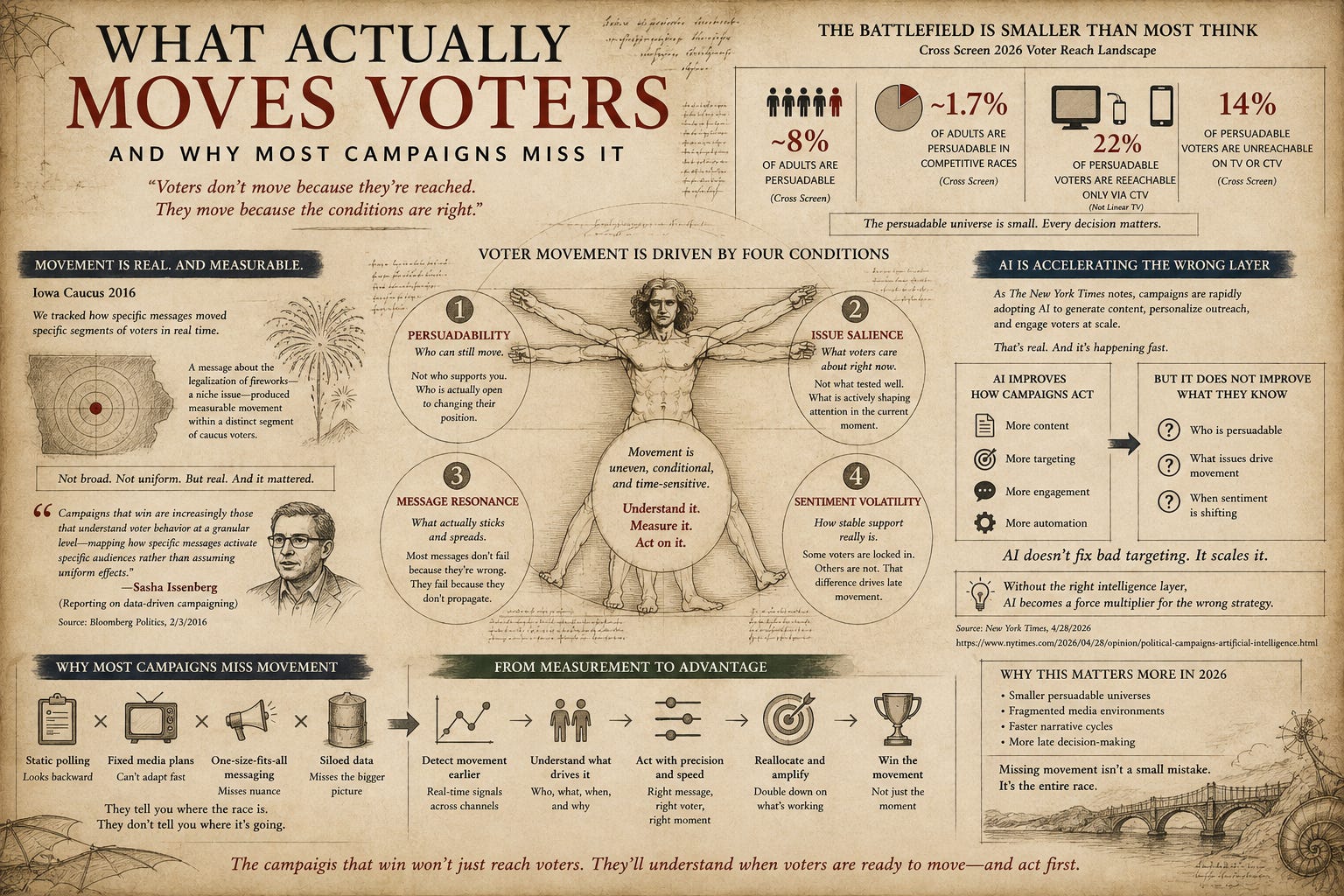
Voters don’t move because they’re reached. They move because the conditions are right.
Movement Is Uneven; And That’s the Whole Game
A recent report from Cross Screen Media made this clear in a different way.
Only ~8% of adults are persuadable
Only ~1.7% are persuadable in competitive races
That means most voters aren’t moving at all.
And the ones who do move:
don’t move evenly
don’t move at the same time
and don’t respond to the same inputs
Political science backs this up. Large-scale campaign experiment research (e.g., American Political Science Review) consistently finds that persuasion effects are heterogeneous and context-dependent.
In plain terms:
Some voters move, BUT most don’t.
Some messages land, BUT most don’t.
We’ve Seen This Up Close
During the 2016 Iowa Republican caucuses, I ran data and polling for Ted Cruz. We weren’t just tracking topline support. We were monitoring how specific messages moved specific segments of voters in real time.
One example stood out.
Not broadly. Not across the electorate. But within a very specific group where that issue mattered.
That kind of movement would never show up clearly in a traditional poll.
But it was real and it mattered.
As Sasha Issenberg has documented in his reporting our data-driven campaign, modern campaigns that win are increasingly those that understand voter behavior at a granular level, mapping how specific messages activate specific audiences rather than assuming uniform effects.
AI Is Accelerating the Wrong Layer
The industry is already moving to the next phase.
As highlighted in this recent New York Times piece, campaigns are rapidly adopting artificial intelligence to:
generate content
personalize outreach
and engage voters at scale
That shift is real and it’s happening fast. But it doesn’t solve the core problem. AI improves how campaigns act. It does not improve what they know. If anything, it makes the gap more dangerous. Because now campaigns can:
produce more content
target more voters
engage more frequently
without improving their understanding of:
who is persuadable (a real GOP media consultant recently said on a call that regression analysis made his “brain hurt”)
what issues are driving movement
when sentiment is shifting
AI doesn’t fix bad targeting. It scales it.
The Four Drivers of Voter Movement
Voter movement isn’t random. It is driven by conditions that can be observed—and measured.
1. Persuadability
Who can still move. Not who supports you or who agrees with you already. Who is open to changing their position. Most campaigns assume this is broad, but it isn’t.
2. Issue Salience
What voters care about right now. Not what tested well. Not what worked last month. What is actively shaping attention in the current moment.
3. Message Resonance
What sticks and spreads. Most messages don’t fail because they’re wrong. They fail because they don’t propagate.
4. Sentiment Volatility
How stable support really is. Some voters are locked in. Obviously others are not. That difference is where “unexpected” outcomes come from.
Most Campaigns Miss This
Because their systems aren’t built to detect it. They have:
polling
media plans
messaging
But those systems are:
static
siloed
backward-looking
They tell you where the race is. They don’t tell you where it’s going.
From Measurement to Advantage
The campaigns that win don’t just:
produce more
spend more
or poll more
They detect movement earlier. They understand:
which voters can move
what will move them
and when that movement is starting
Then they act.
And This Matters More in 2026
Everything is amplifying this dynamic:
Smaller persuadable universes
Fragmented media environments
Faster narrative cycles
More late decision-making
Cross Screen’s data shows just how small the true battlefield is.
Which means missing movement isn’t a small mistake. It’s the entire race.
The Bottom Line
Campaigns don’t lose because they fail to reach voters. They lose because they don’t understand what actually causes voters to move.
They:
measure position instead of conditions
optimize for efficiency instead of change
react after the movement has already happened
In 2026, that won’t be enough. The campaigns that win won’t just reach voters.
They’ll understand when voters are ready to move, and act first.
Final Line
Voters don’t move because they’re reached. They move because the conditions are right.