
The Volatility Problem
Why some polling leads collapse while others harden; and why most campaigns don’t know the difference.

Today, Texas Republicans are watching what may become one of the defining tests of modern political volatility: Ken Paxton versus John Cornyn.
Most analysis of races like this still focuses on:
polling margins,
spending decisions (campaign and outside),
endorsements,
advertising,
consulting teams,
and media coverage.
Those things matter (some a lot more than others).
But increasingly, they are not the most important variables.
The more important question is: How durable is the coalition underneath the numbers?
Because two candidates can poll similarly and possess completely different levels of support stability.
One coalition may be hardening. The other may already be quietly fracturing underneath the surface.
Traditional polling often treats those situations as identical. They are not even remotely the same.
The Biggest Mistake Campaigns Make
Most campaigns assume support is uniform. It isn’t.
A candidate sitting at:
46%,
solid favorables,
strong name ID,
and acceptable job approval
can still be sitting on an extraordinarily fragile coalition.
Another candidate with similar toplines may possess:
emotionally durable support,
activist intensity,
stronger identity alignment,
and lower volatility.
Those are very different political positions.
But topline polling often struggles to distinguish between them. That is where many so-called “surprise” outcomes come from. Not polling failure.
Volatility failure.
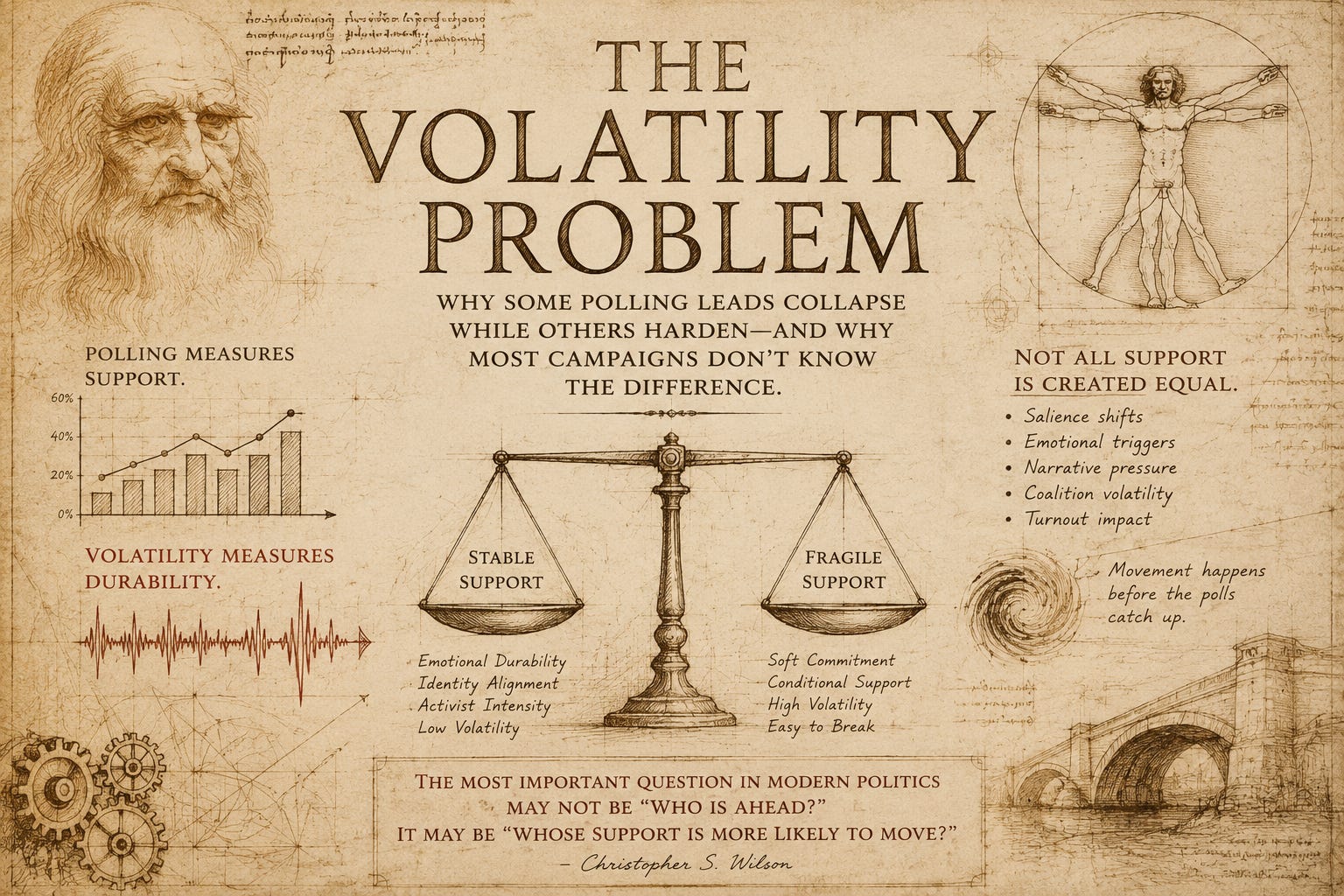
Polling Measures Support. Volatility Measures Fragility.
This distinction matters enormously. Polling generally measures:
expressed preference,
current position,
and declared support.
Volatility measures something different: How easily that support can break, shift, or accelerate under pressure.
And in modern politics, pressure arrives faster than ever. Because today’s campaigns operate inside:
compressed news cycles,
fragmented media ecosystems,
algorithmic amplification,
and emotionally charged narrative environments.
That changes how coalitions behave. Support is no longer static. It is increasingly conditional.
Some Coalitions Harden Under Pressure. Others Fracture.
This is one of the most misunderstood dynamics in politics.
Some political coalitions become stronger when attacked. Criticism reinforces:
identity,
tribal attachment,
emotional commitment,
and turnout intensity.
Other coalitions do the opposite. Under pressure, they soften:
enthusiasm drops,
volatility increases,
turnout weakens,
and persuadable voters begin drifting.
The problem is that both coalitions can initially look very similar in polling. That is why campaigns that appear stable sometimes collapse rapidly late in races. The warning signs often existed long before the toplines moved.
We’ve Seen This Repeatedly in Recent Cycles
In the 2024 Texas Republican primaries, several incumbents entered the cycle with:
structural advantages,
strong fundraising,
institutional support,
and seemingly stable positions.
Many still lost. Why? Because underneath the toplines:
ideological intensity was shifting,
anti-establishment pressure was building,
issue salience was changing,
and coalition volatility was rising.
The campaigns that recognized those conditions early adapted. The campaigns relying solely on traditional assumptions often reacted too late.
That pattern has repeated itself across modern politics:
late movement,
compressed persuasion windows,
rapid coalition shifts,
and turnout volatility among voters traditional polling often underestimates.
Those outcomes are rarely random. Most are signs of movement building underneath the surface long before Election Day.
AI Is About to Accelerate Volatility
This dynamic becomes even more important in the AI era.
A recent study from researchers at Oxford, Stanford, the UK AI Security Institute, and the London School of Economics found that conversational AI significantly increased real-world political behavior and activism. (If I have any “regular readers” I recognize this is the third time I’ve written about this study, but it is stunning to me it’s not getting more attention as it is truly revolutionary to how campaigns should be operating).
But the most important implication may not be persuasion itself. It is speed.
AI accelerates:
engagement,
emotional activation,
issue amplification,
identity reinforcement,
and behavioral movement.
That means coalition volatility may now develop faster than traditional systems can fully detect.
In other words: Political coalitions are becoming more dynamic precisely as campaigns become more dependent on static measurement systems.
That is a dangerous combination.
This Matters To Me Personally
One of the reasons I joined EyesOver as CEO in January 2025 was because I saw firsthand during the 2024 cycle how useful real-time sentiment and movement analysis had become in understanding races traditional systems struggled to fully explain.
Since taking over, one of our major focuses has been evolving the platform beyond simple sentiment tracking and building tools designed to better identify:
volatility,
salience shifts,
movement conditions,
and coalition instability in real time.
Because increasingly, the most important strategic question in campaigns is no longer simply: “Where is the race?”
It is: “How stable is the race underneath the surface?”
That distinction matters more every cycle.
The Real Battlefield
The most important number in modern politics may no longer be: “Who is ahead?”
It may be: “Whose support is more likely to move?”
That is a fundamentally different way of thinking about campaigns.
Because the future divide will not simply be between:
Republicans and Democrats,
digital and television,
or AI and traditional campaigning.
It will increasingly be between campaigns that understand volatility and campaigns that do not.
The winning campaigns will be the ones that can distinguish:
stable support from fragile support,
attention from activation,
and polling position from movement probability.
That is the real battlefield now.
The Bottom Line
As Republicans watch the Paxton versus Cornyn race unfold tonight, the broader lesson extends far beyond this single runoff.
Modern campaigns are no longer operating in stable political environments.
They are operating inside rapidly shifting emotional, behavioral, and informational systems.
And in that world: Polling measures support. Volatility measures durability.
The campaigns that win will increasingly be the campaigns that understand the difference before everyone else does.