
Strike When They’re Weak: The Hidden Power of Sentiment Lows
How real-time sentiment drops reveal the perfect moment to strike

Not long ago, a high-profile political figure walked into a televised gauntlet—facing hostile questions, national scrutiny, and plenty of partisan fire.
What happened next surprised everyone: she dominated.
Not because she had the best lines or the biggest platform—but because she knew exactly who her softest targets were. She had the emotional map. While the media was watching posture, she was watching posture plus panic.
She’d seen the drop. And she knew where to push.
We can’t say who. But we can say this:
Sentiment lows are the most underused advantage in political warfare.
Most People Watch for the Highs—The Smart Ones Watch for the Lows
Campaigns love good news. Favorable coverage. Retweets. Fire emojis.
But momentum doesn’t only come from your side rising—it often comes from the other side falling.
That’s where regular sentiment monitoring comes in.
While traditional tools show what people are saying, sentiment tracking (like EyesOver) tracks how strongly they feel about it—and when that emotional current flips against someone, fast.
We call those moments sentiment lows—and if you know where they are, you know when to strike.
Case Study: Ossoff’s Sentiment Collapse
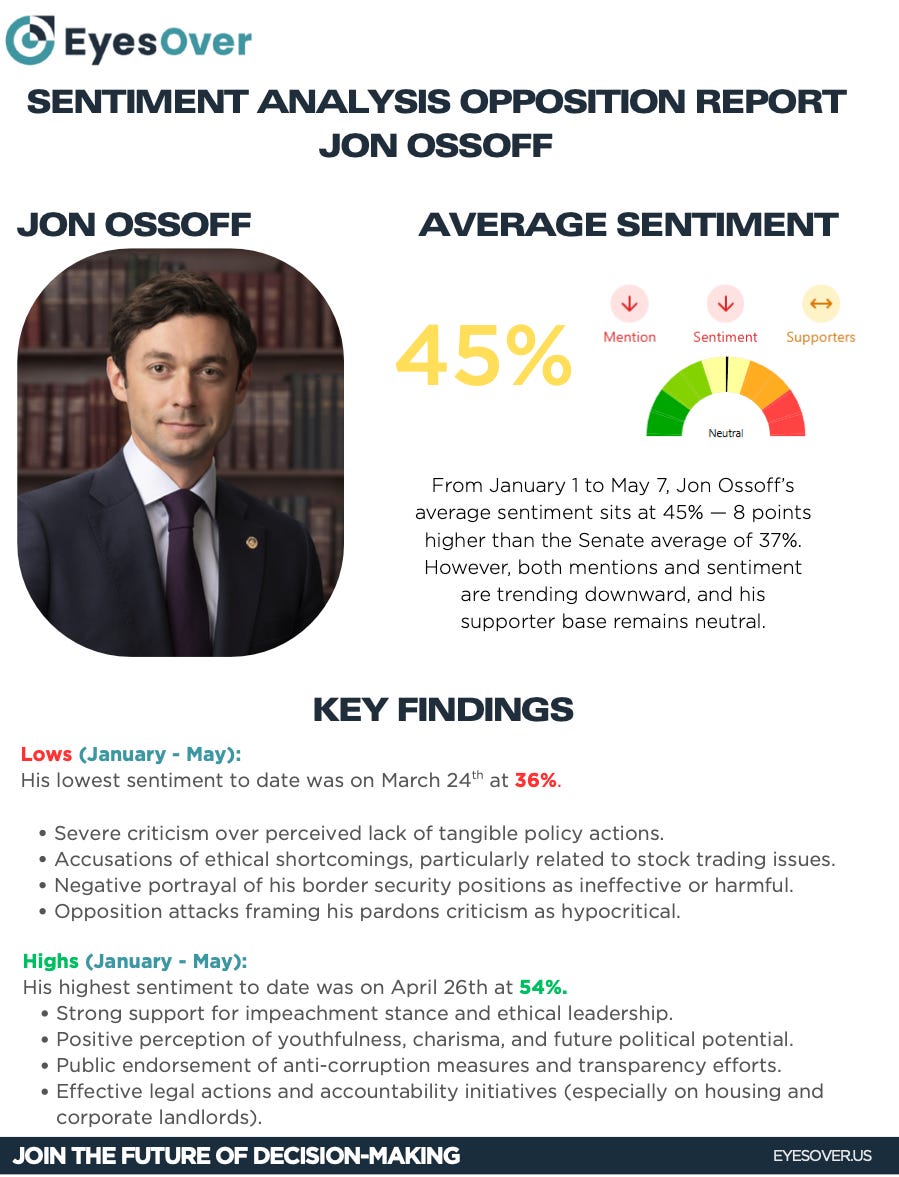
Between January and May, Jon Ossoff’s average sentiment was a respectable 45%—well above the Senate average of 37%. But averages are misleading.
On March 24th, Ossoff’s sentiment crashed to 36%, the lowest of his cycle. The emotional drivers? Not some major scandal. But a mix of:
Weakness in political identity
Absence from key debates
Questions around leadership
Lack of authenticity
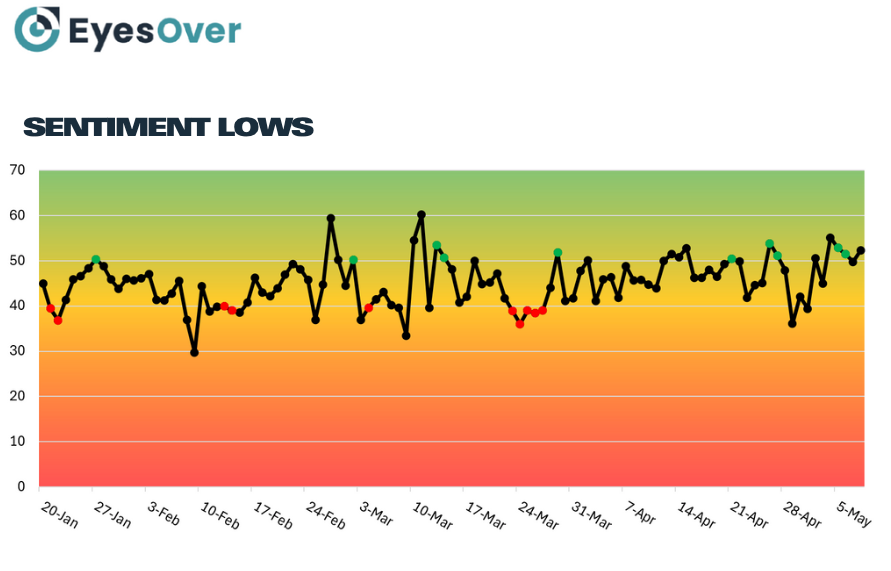
Imagine running a contrast ad or influencer push that week. Voters were already doubting him—your job would just be to amplify what they already felt.
No persuasion needed. Just timing.
The Trick: Watch for Soft Spots, Not Just Surges
We see this again and again.
A senator’s support for gun policies tanks with conservatives.
A legislator gets caught between free speech and censorship narratives, eroding trust from both sides.
A corporate exec is accused of hypocrisy on ESG while their brand sentiment quietly drops 10 points overnight.
These aren’t campaign issues—they’re emotional entry points. And the smart players use them to:
Push narrative flips when trust is fragile
Deploy surrogates who reinforce criticism while it’s peaking
Reframe contrast while the other side is still stammering for a response
Real-World Example: Senators on the defensive
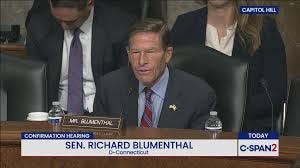
Earlier this year, our system was used to analyze sentiment across key power brokers ahead of a major public showdown.
Let’s just say… some decision-makers walked into that moment with live intelligence on which of their opponents were losing support among independents, facing credibility erosion, or vulnerable to very specific lines of attack.
They didn’t need to go on offense across the board. They just needed to press where it already hurt.
And it worked.
That’s the power of real-time negative sentiment tracking.
Historical Parallel: When “Low Energy” Was a Strategy
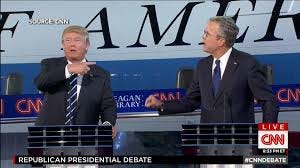
Think back to 2016. Jeb Bush was technically polling fine early on. But sentiment data (if we’d had it then) would’ve shown the cracks:
Frustrated base
Poor response to attacks
General fatigue
Trump’s “low energy” line wasn’t just clever—it was perfectly timed, just as voters were emotionally distancing from Jeb.
He didn’t need new facts. He just needed to echo the emotional drift.
Campaigns. Brands. Movements. It’s All the Same Game.
Whether you’re running a Senate race, managing a PR crisis, or trying to outmaneuver a corporate competitor, here’s the playbook:
Don’t just track sentiment highs.
Find the lows.
Move while they’re still falling.
EyesOver does this for you—across every issue, every region, every voter type.
And when the next big moment comes, you won’t be watching.
You’ll be winning.