
Intelligence Doesn’t Win Campaigns
Execution Does

Campaigns in 2026 have access to more information than at any point (to date) in political history.
We can observe narrative velocity in real time.
We can track reinforcement patterns across digital networks.
We can monitor emotional shifts before they appear in surveys.
Campaign strategists now operate with tools that would have seemed like science fiction when I ran data and digital on Cruz for President in 2016.
But the past few weeks offered a reminder of something older and much simpler.
Information does not win campaigns. Execution does.
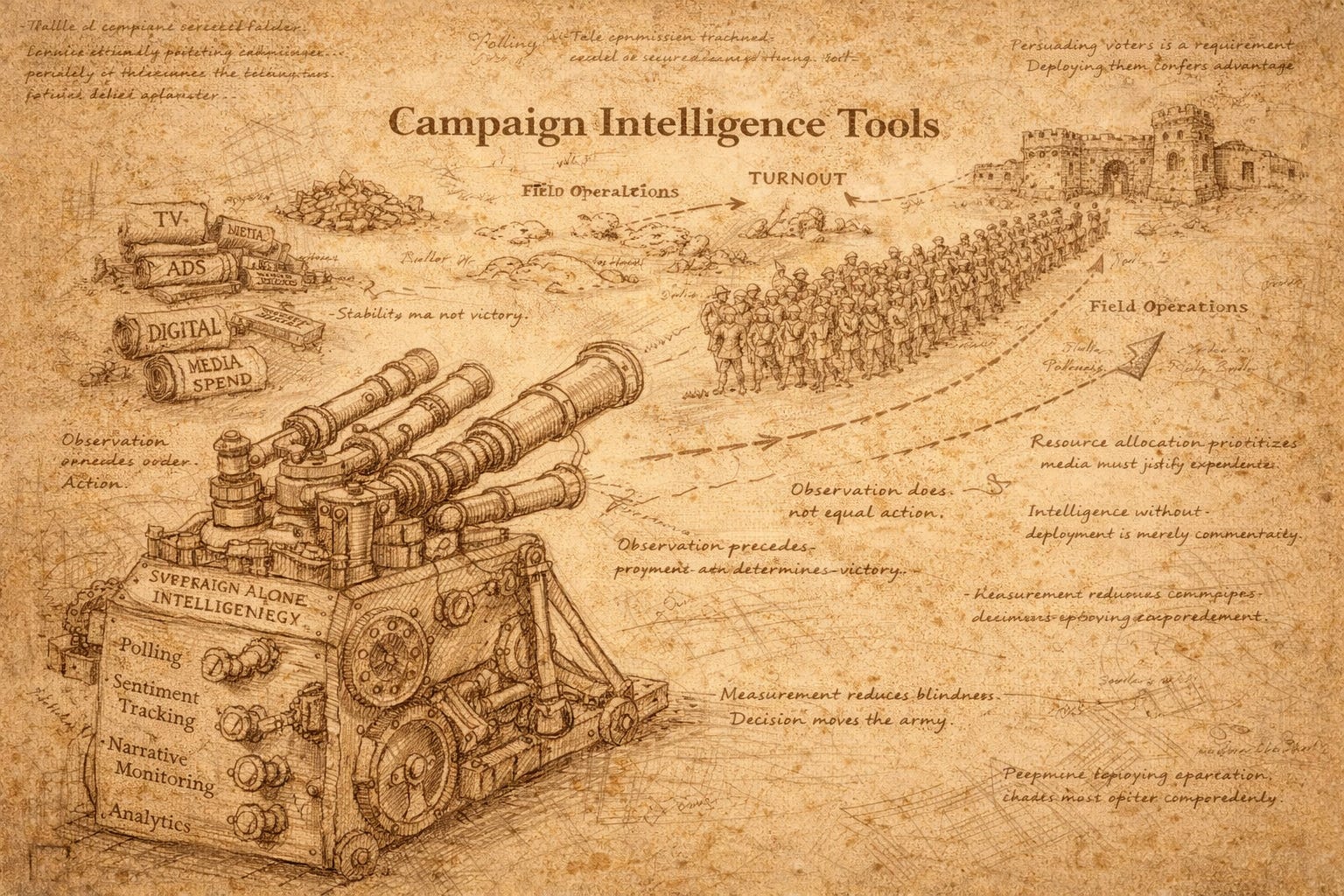
The Illusion of Strategic Control
The rise of analytics has created a quiet assumption in modern politics: that better information automatically produces better outcomes.
If we can see the environment clearly enough — if we can monitor sentiment, track narratives, and model voter behavior — then the campaign will naturally move toward the correct decisions.
But campaigns are not prediction engines. Political campaigns are, at their first principle, organizations. And organizations succeed or fail based on their ability to act.
Intelligence can reveal what is happening. It cannot force a campaign strategist to respond correctly or act accordingly.
When the Intelligence Picture Is Clear
In a recent high-profile race, campaigns had access to nearly every modern monitoring capability available today.
The campaign environment could be observed continuously. Narrative shifts were visible. Reinforcement patterns were measurable. The intelligence picture was not mysterious. Public messaging from the campaign emphasized that it was spending less while maintaining a polling lead.
But having a lead and executing on it are two different things.
Campaigns still require the same operational fundamentals they always have:
message discipline (or even having a message)
quick decision-making (no paralysis through analysis)
organizational alignment (or even having an organization)
effective resource deployment (not putting it all on TV)
field execution (or even having a field program)
When those elements break down, intelligence becomes observation and not strategy.
Data can warn you about the cliff. It cannot steer the car.
The Incentive Problem Inside Modern Campaigns
There is another structural challenge that receives far less attention.
Modern campaigns are surrounded by vendors whose compensation models are tied directly to media placement.
Television advertising. Radio advertising. Digital advertising.
In each of these sectors, commissions often accompany the placement of media. In digital advertising especially, the layers of buying, optimization, and placement can create commission structures that are surprisingly large. In some cases, once production and placement fees are combined, effective commissions can approach or even exceed fifty percent.
All too often that incentive structure shapes the strategic decisions inside campaigns.
When the professional ecosystem surrounding a campaign is rewarded for placing media, the strategic dialogue tends to revolve around media solutions.
Spend more. Add another flight. Increase frequency. Buy more digital.
None of those tools are inherently wrong. Persuasion matters.
But persuasion is only one half of winning elections.
The other half is making sure your supporters turn out and vote.
What Doesn’t Pay Commissions
Grassroots organization rarely generates commissions. Volunteer recruitment does not produce placement fees. Get-out-the-vote operations do not generate media percentages.
Field programs require staff, discipline, and relentless management. They involve building networks of volunteers, organizing precinct-level activity, and executing complex turnout plans over weeks and months.
Grassroots is operationally demanding. And they are not replaceable by a paid field program.
Because grassroots work does not carry the same financial incentives for vendors, field operations are often among the first areas squeezed in many campaigns.
The result is a pattern that appears repeatedly in modern politics:
Massive investment in persuasion infrastructure
paired with
comparatively weak turnout infrastructure.
Campaigns become optimized to influence voters who may already be inclined to support them, while underinvesting in the organizational work required to ensure supporters actually turn out and vote.
No amount of monitoring technology can correct that imbalance.
Intelligence Has Three Real Jobs
Campaign intelligence systems serve three legitimate purposes.
First, they detect environmental shifts early. Monitoring tools can identify narrative movement before polling stabilizes.
Second, they reduce strategic blindness. Good research helps campaigns avoid misreading the electorate.
Third, they enable faster decision-making. Information should allow campaigns to act more quickly and with greater clarity.
But information alone does not execute those decisions.
A campaign still has to:
move resources
adjust tactics
deploy field operations
activate supporters
get voters to the polls during early voting or on Election Day
Without that operational capacity, intelligence remains descriptive rather than strategic.
The Execution Gap
Most campaigns do not fail because they lack information.
They fail because they cannot translate information into coordinated action.
Execution failures tend to appear in familiar ways:
Internal factions slow decisions.
Messaging becomes reactive rather than disciplined.
Resource allocation follows vendor incentives rather than strategic necessity.
Field operations remain underdeveloped until the final weeks of a campaign.
None of these problems are analytical. They are organizational.
The Moment That Ultimately Matters
Every election eventually arrives at the same point.
After the messaging. After the advertising. After the polling and monitoring.
A campaign still needs voters to appear at polling locations.
Turnout does not occur automatically.
It requires:
reminders
volunteer contact
social reinforcement
logistical organization
operational discipline
The most advanced analytics, polling or sentiment analysis in the world cannot substitute for those fundamentals.
Campaigns still win when they combine good information with effective execution.
The Real Lesson
Over the last decade, the political industry has produced extraordinary advances in campaign intelligence.
We can see more of the battlefield than ever before. But visibility alone does not determine the outcome of a battle.
Execution does.
Campaigns that rely exclusively on tools often discover this too late. Campaigns that pair intelligence with disciplined organization still win the way campaigns have always won:
By executing better than their opponent.
The Strategic Takeaway
Campaign intelligence is enormously valuable. Monitoring systems reveal narrative shifts. Polling confirms stabilization. Analytics illuminate persuasion opportunities.
But none of those tools can rescue a campaign that lacks operational discipline.
The most dangerous mistake a modern campaign can make is believing that information itself creates advantage. It does not.
Information strengthens campaigns that can execute. And execution remains the hardest part of politics.